
The Natal Society Foundation
Welcome to the Natal Society Foundation’s web page which promotes its historical journal, Natalia, to a wider audience. The entire contents of all back numbers have been digitised and may be downloaded from this site free of charge, as can our publications.
Here also you can find a history of the Natal Society and information about the NSF’s Special Collections Library of Nataliana, Africana, and Victoriana books, documents, photographs and maps.
| This page was last updated on 12 March 2026 |
The History of the Natal Society
The Natal Society has been a cornerstone of Pietermaritzburg for more than 175 years, dating back to when the city was a small village with a population of fewer than 1,500 people.
While best known for establishing the country’s largest privately owned public library system, the Society also laid the foundations for several of the region’s most iconic institutions:
- The Natal Museum
- The Royal Agricultural Society
- The Natal Society Drama Group
The Early Years: 1846–1850
The organization began its life in 1846 as the Book Society of Pietermaritzburg, consisting of a simple reading room, a fledgling library, and the earliest beginnings of a museum.
In that same year, David Dale Buchanan, a bold young journalist from the Cape, arrived by ox wagon with a second-hand printing press to found the Natal Witness (now the country’s oldest surviving newspaper). As a champion of public education and secretary of the Book Society, Buchanan persuaded the committee by 1849 to convert the collection into Pietermaritzburg’s first public library.
Despite his zeal, early interest was low. Subscriptions barely covered the rent of their small hired room. Most books were on loan, primarily from the personal collection of Henry Cloete, the British Commissioner and future first judge-president of Natal.
Expansion and Mission: 1851
In May 1851, the Natal and East African Society was launched (later shortened to simply the Natal Society). Its primary mission at the time was:
“…to tell the truth about conditions in the colonies.”
This was a response to thousands of British settlers being lured to Africa by inflated promises, only to face unexpected hardship.
The Birth of the Royal Agricultural Society
Also in 1851, the Society organized the first in a series of annual agricultural shows. This led to the birth of the Agricultural Society, which eventually became the Royal Agricultural Society in 1905.
Formalization and Growth: 1865–1878
By 1865, the Natal Society absorbed the original Book Society and redefined its core purpose:
“The acquisition and preservation of information of local value and interest, and the general encouragement of habits of study, investigation and research.”
A formal committee was established to curate a museum collection. After years of moving between hired premises, a major turning point occurred in 1876. The Society held a “grand bazaar and colonial exhibition” which successfully raised 2,000 guineas.
A Permanent Home
With these funds, the Society purchased Erf 20 (fronting Longmarket Street and extending along Theatre Lane). In February 1878, they opened a dedicated library and museum to the public.
At the time, it was considered the finest public library in the Colony. However, the museum collection was growing so rapidly that it eventually outgrew the space.
The 20th Century Legacy
To ensure the continued growth of the museum, the Natal Society persuaded the colonial government to take it over in 1901. This led to the opening of the new, independent Natal Museum premises in November 1904, allowing the Society to refocus its efforts on its legendary library system.
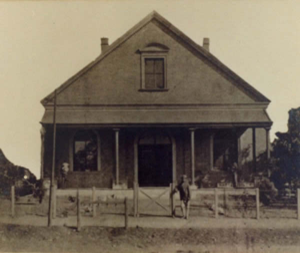
The original Natal Society Library, Longmarket Street, 1878
At union in 1910, the Natal Society Library received formal recognition as one of South Africa’s four major libraries granted legal deposit status. This required a copy of every book published in South Africa to be lodged with the library for copyright and archival purposes.
To cope with the resulting explosion of its collection, the library underwent several expansions:
- 1929: A new double-storey building was added to the front of the Longmarket Street premises.
- 1957: The Lambert Wilson students’ library in Market Square was donated to alleviate pressure for reader accommodation.
- 1963: The Weinronk building in Commercial Road was leased specifically to house the massive copyright and archival collection.
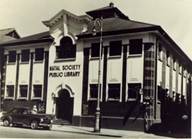
Natal Society Library, Longmarket Street, 1954
The Move to a Public Utility: 1967–2005
While the library’s main income for salaries and book purchases initially came from members’ subscriptions, it became a free lending library in 1967. This transition was made possible by an agreement with the municipality, which undertook the financing of the institution from that point forward.
The Longmarket Street premises served as the city’s library until 1975, when a new facility built by the Pietermaritzburg City Council was opened in Church Street, situated behind the City Hall. The original Longmarket Street building was subsequently taken over by the council and later acquired by PADCA.
The driving force behind the free library and the new building came from two dedicated women:
- Pamela Reid: City councillor and later mayor, who served on the Natal Society council for 33 years.
- Sue Judd: The chief librarian for 24 years.
Resistance and Inclusivity
During the 1980s, the Natal Society successfully resisted a takeover bid from the province. More significantly, it stood firm against attempts by the National Party government to segregate the library. By ensuring the system remained open to all residents irrespective of race from the mid-1970s onwards, the Society maintained its integrity as an inclusive public resource. Despite political interference, branches were expanded into Georgetown, Woodlands, Eastwood, Northdale, Sobantu, and Ashdown to serve disadvantaged communities.
The Final Transition
On 1 April 2004, facing the crippling rising costs of salaries and book acquisitions, the Natal Society finally relinquished control over the city’s library system, transferring all stock and staff to the Msunduzi Municipality. In June 2005, the main library was officially named after the renowned writer Bessie Head, marking the end of an era for the Society as a private administrator of public knowledge.
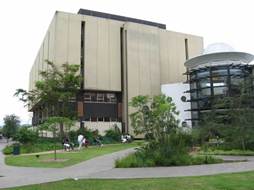
Bessie Head Library, Church Street, 2009
The Natal Society Foundation Trust (NSFT)
Following the 2004 transition, the organization became the Natal Society Foundation Trust (NSFT), remaining dedicated to its original aims. For several years, it awarded scholarships to students in need while continuing to publish and promote the historical journal, Natalia, which was originally founded in 1971. Its significant archival holdings—the O’Brien, Hattersley, and Africana collections—were initially housed by and subsequently ceded to the Alan Paton Centre at the University of KwaZulu-Natal.
Between 2010 and 2025, the NSFT remained prolific, publishing seventeen volumes of monographs in addition to the annual volumes of Natalia. Adapting to the digital age, the last two titles of this period were produced as e-books.
Since 2025, the Trust has shifted its focus toward the maintenance and expansion of its digital presence and website. Natalia is now an online-only publication, and in alignment with its original 19th-century objectives, the NSFT is a dedicated supporter of open access through Creative Commons licensing.
TRUSTEES OF THE NATAL SOCIETY FOUNDATION
Michelle Bartlett
Christopher Merrett
Phila Msimang
Nalini Naidoo
Gillian Richmond
HONORARY TRUSTEES
Jo Marwick
Patricia Stabbins
Shona Wallis
Photo of the KZN Midlands by Gillian Richmond
Further information about the Natal Society Foundation Trust is available from its Administrator,
If you would like news about this website and notification of additions to it, please send your name and email address to the administrator
Acknowledgments and Research
The contents of this history were researched, written, and edited by Peter Croeser of the Natal Society Foundation. Significant contributions and input were provided by:
- Former Editors of Natalia: T.B. “Jack” Frost, Adrian Koopman, and Elwyn Jenkins.
- NSF Trustees, particularly Christopher Merrett.
- NSF Honorary Associate, Pat McKenzie.
- Jewel Koopman, retired former Director of the Alan Paton Centre & Struggle Archives.
