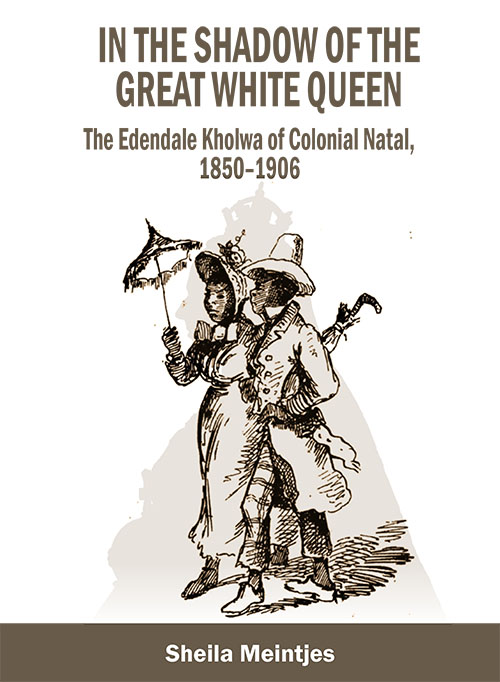
In The Shadow of The Great White Queen

The Edendale Kholwa of Colonial Natal

1850–1906

by

Sheila Meintjes
In The Shadow Of The Great White Queen

Occasional Publications imprint
of 
The Natal Society Foundation.
PIETERMARITZBURG

This history of one of the earliest nineteenth-century mission stations in Natal traces the transformation in the lives of a community that settled first at Indaleni near Richmond and later at Edendale a few miles from Pietermaritzburg. Initially an independent mission under the religious and educational tutelage of James Allison, who left the Methodist Church to pursue independent mission work, Edendale was the first African community in Natal to experiment with freehold tenure. This had implications for the way its inhabitants were integrated into colonial society as educated, market-orientated producers and as citizens. They sought equal recognition, no different from British settlers. The concerns of this case study return to questions that dominated materialist debates in the 1980s, when the thesis on which this book is based was written. How did social relations of production and reproduction of communal kinship society mesh with those of the colonial capitalist economy, which in the nineteenth century was essentially a petty commodity economy within the beginnings of a plantation nexus? What were the mechanisms that led to the transformation of political and other social relations? How did ideological change occur in the context of religious conversion? Focus on a single community enables exploration in concrete detail of the matrix of forces that shaped changing social consciousness, family structure, patterns of marriage and inheritance, property ownership, corporate structures, and institutions in the village community. As Marx and Engels wrote in ‘The Eighteenth Brumaire’, ‘Upon the different forms of property, upon the social conditions of existence arises an entire superstructure of distinct and peculiarly formed sentiments, illusions, modes of thought and views of life. The entire class creates and forms them out of its material foundations and out of the corresponding social relations’. While the larger forces of capitalism in the nineteenth century provide a backdrop to the study, it is their translation in the lives of indigenous peoples that is of consequence. It is through the prism of a small, peripheral colony in the nineteenth century that we can see how they unfold and transform people’s lives at the level of village life. For those living in colonial Natal, it was the Victorian imperial state represented by its small cohort of officials on the ground that overshadowed social and political relationships. But at the local level, people reacted, adapted and opposed these forces to create their own existence. The Edendale community shows this syncretic process very clearly.

Sheila Meintjes taught Political Studies at the University of the Witwatersrand for 30 years. Her initial research interest in the historical transformations of independent precolonial polities to subordinate colonies during the nineteenth century transitioned to a focus on gender and women in both her research and teaching. She is an honorary research associate professor in the Department of Political Studies at Wits, and a visiting professor at the Institute for Women and Gender Studies, Carl von Ossietzky University, Oldenburg, Germany.

Book details

Publisher:The Natal Society Foundation
Publication Date:2020
Binding:Paperback, section sewn
Text:322 pp. illustrated with photographs
Dimensions:
ISBN:978-0-6398040-0-2
Price:R200
Editors:Peter Croeser, Phila Mfundo Msimang and Christopher Merrett
Indexer/s:Christopher Merrett
Proof Reader:Catherine Munro
Design and Layout:Jo Marwick
Printed by:CPW Printers, Pietermaritzburg

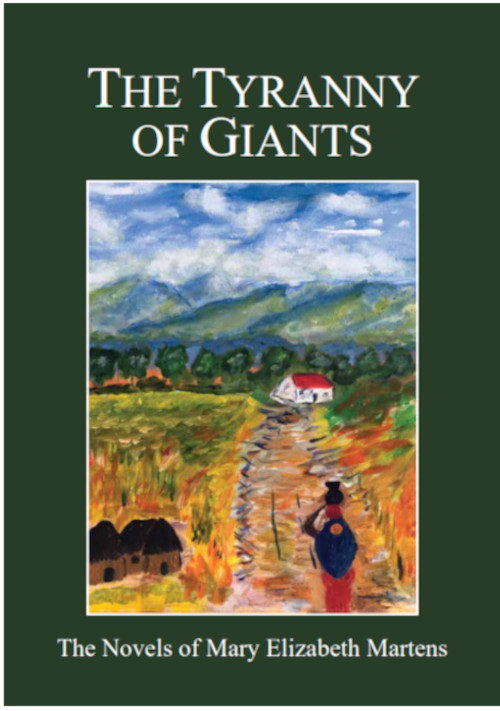
The Tyranny of Giants

The Novels of Mary Elizabeth Martens

The Tyranny of Giants

Occasional Publications imprint
of 
The Natal Society Foundation.
PIETERMARITZBURG

The journalist Mary Elizabeth Martens (1870–1939), who had grown up in the Colony of Natal under Responsible Government, published two novels in 1911 and 1915: A Woman of Small Account and A Daughter of Sin. Like the writing of most women of her era, in the words of Valerie Letcher these novels ‘disappeared from the South African literary consciousness’. Agreeing with Letcher that recognition is overdue, the novels were rescued by two of Martens’ great granddaughters, Lynn McMaster and Nancy Bowring, and are republished in modern format together with biographical and historical background. They contain significant social commentary on their times, portraying suffocating patriarchy in which wives and children were regarded and treated as property. White men could behave as they pleased, while white women who transgressed were regarded as ‘fallen’ and sometimes punished as criminals. The penalties for black men who crossed racial boundaries were extreme. Of A Woman of Small Account, a contemporary reviewer wrote ‘The book, though it assumes the guise of a story, is a powerful plea, worthy of Olive Schreiner, for the fair treatment of the natives of South Africa, male and female’ (The Advertiser (Adelaide), 23 September 1911). Recurrent moral panics were fuelled by male psychological insecurity about race and early stirrings of feminism evident in suffragism. Fear of challenge to the social order manifested itself in misogyny and racism in a rural society that was philistine and backward. These themes emerge strongly from Martens’ writing, which required considerable courage for her time just over a century ago.

Book details

Publisher:The Natal Society Foundation
Publication Date:2020
Binding:Paperback, section sewn
Text:348 pp
Dimensions:24cm x 17cm
ISBN:978-06398040-2-6
Price:R200
Editors:Christopher Merrett, Lynn McMaster & Nancy Bowring
Transcriber:Suzie van der Merwe
Proof Reader:Catherine Munro
Design and Layout:Jo Marwick
Printed by:CPW Printers, Pietermaritzburg

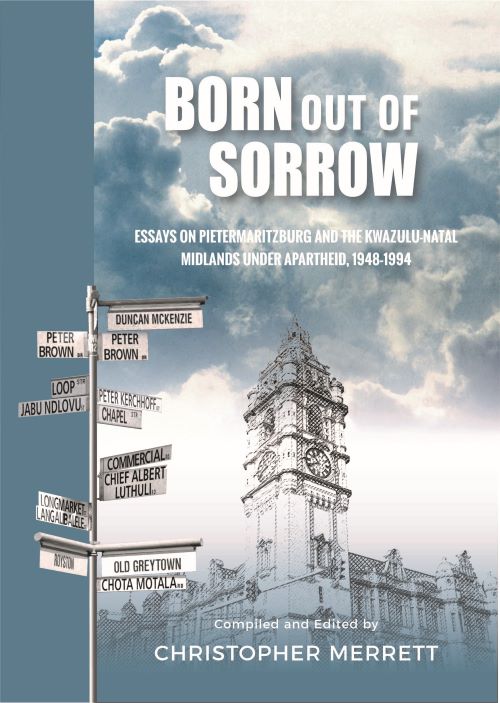
Born out of Sorrow

Essays on Pietermaritzburg and the KwaZulu-Natal Midlands under Apartheid, 1948−1994

Volume One

Compiled and edited by Christopher Merrett

Born out of Sorrow

Occasional Publications imprint
of 
The Natal Society Foundation.
PIETERMARITZBURG

HALF the size of New York cemetery and twice as dead: this much-quoted, wry comment is generally attributed to the satirical writer Tom Sharpe who worked in Pietermarizburg in the 1950s. Also described as ‘sleepy hollow’ and the ‘last outpost of the British Empire’, Pietermaritzburg in fact possesses a rich history that highlights many key areas of South Africa’s past. This is particularly true of the apartheid period.
This is the first book published on the history of the city and region as a whole in over thirty years. It contains chapters on urban geography, the regional civil war, detention without trial, the black trade union movement, and political trials; biographical contributions on Chief Mhlabunzima Maphumulo and women of the Black Sash; and organisational memoirs of the Pietermaritzburg Agency for Christian Socal Awareness, Kupugani and the Association for Rural Advancement.
The object of this series is to present fresh perspectives on the city and region’s apartheid history. It takes a position that South Africa was liberated by all of its people – not one particular self-regarding vanguard movement with its hegemonic, one-dimensional views.

Book details

Publisher:The Natal Society Foundation
Publication Date:2021
Binding:Paperback, section sewn
Text:312 pp
Dimensions:24cm x 17cm
ISBN:978-06398040-1-9
Price:R200
Editor:Christopher Merrett
Cartographer:Marise Bauer
Proof Reader:Catherine Munro
Design and Layout:Jo Marwick
Cover:Marise Bauer
Printed by:CPW Printers, Pietermaritzburg

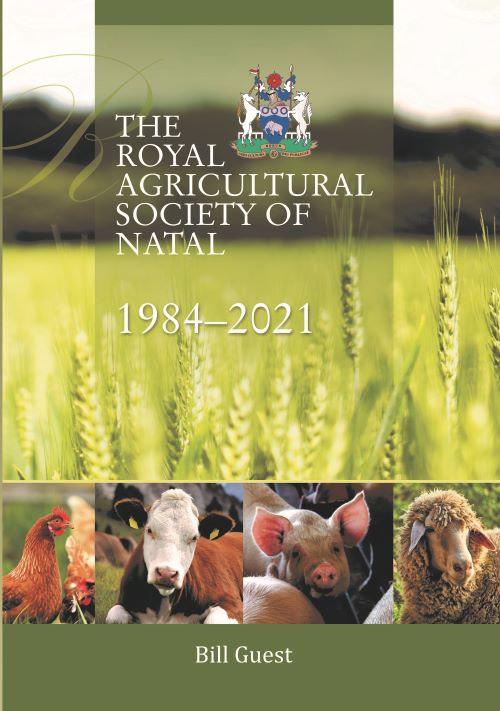
The Royal Agricultural Society of Natal

1984 – 2021

The Royal Agricultural Society of Natal 1984 - 2021

Occasional Publications imprint
of 
The Natal Society Foundation.
PIETERMARITZBURG

The Royal Agricultural Sociey of Natal (RAS) is one of KwaZulu-Natal’s oldest and best-known institutitions. This volume provides a detailed overview of two earlier accounts of its history since 1851 and updates it from 1984 to 2021. It is a story of dramatically fluctuating fortunes, which in many ways reflects the experience of the whole province and, in particular, its agricultural sector.
In the face of financial, politial and other uncertainties the RAS developed its property into the largest mixed exhibition centre in South Africa. This was due in large measure to firm but prudent leadership as well as the dedication of a small, reliable staff complememt and the enthusiasm of numerous volunteers who served the institution in a wide range of capacities
From the 1980s Pietermaritzburg’s well-known Showgrounds became the venue not only for the internationally renowned annual Royal Show but an increasing variety of functions. Its facilities comfortably hosted birthday parties, wedding receptions, funerals, the launch of new motor car models and agricultural equipment, equestrian and livestock events, graduation ceremonies and lavish openings of the provincial legislature. Not least, the annual Garden Show attracted increasing nationwide attention.
Virtually all these activities were abruptly truncated by the Covid-19 pandemic of 2020/2021. This had particularly adverse effects on the exhibition industry, although the Showgrounds did generate some alternative income as a provincial quarantine field hospital.
The book concludes with the debate surrounding the sale of that property, which had become increasingly difficult to operate as a a venue for agricultural events as it was gradually enveloped by urban sprawl. Hence the RAS decision in 2021 to search for alternative land on the fringes of Pietermaritzburg that was better suited to its all-important agricultural purpose while continuing to meet the expectations of the city.

Book details

Publisher:The Natal Society Foundation and Royal Agricultural Society of Natal
Publication Date:2022
Binding:Paperback,section sewn
Text:267 pp
Dimensions:24cm x 17cm
ISBN:978-06398040-4-0
Price:R 200
Editor:Christopher Merrett
Indexer/s:Cynthia and Bill Guest
Design and Layout:Jo Marwick
Cover:Marise Bauer
Printed by:CPW Printers, Pietermaritzburg

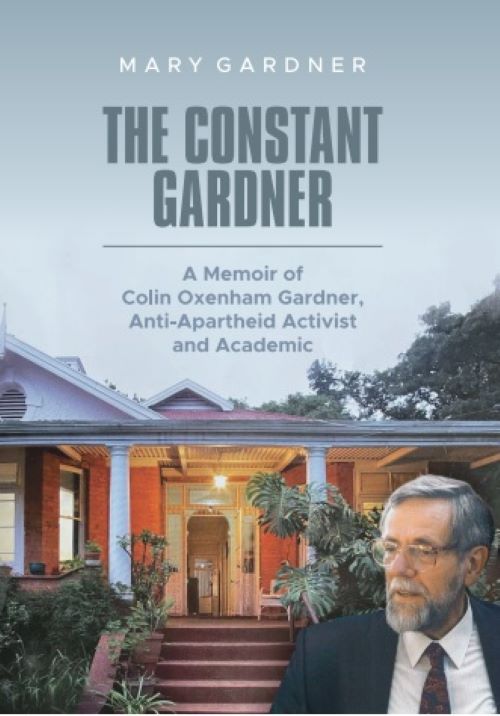
The Constant Gardner

A Memoir of Colin Oxenham Gardner, Anti-Apartheid Activist and Academic

The Constant Gardner

Occasional Publications imprint
of 
The Natal Society Foundation.
PIETERMARITZBURG

During the apartheid era Pietermaritzburg was home to a significant number of liberal figures. Among them was Colin Gardner, professor of English at the University of Natal, who after retirement became the first speaker of the Msunduzi Council. He died in 2013 and in this memoir has been written by his wife Mary with additional contributions from activists and academics.
The details of Colin’s career in university and public life reflect a vanishing world. He did not have a doctorate, nor publish a major book. Instead, he concentrated on teaching, influencing many minds and subsequent careers; on reviewing; and on conference papers and articles in journals. His writing included many letters to and opinion pieces in the local press. Thus, the overlap with his civil society persona.
He was involved with a wide range of organisations that reflected his concerns for humanity and the environment. As a committed Catholic, there was early involvement in the student Christian movement. As a political activist he was a prominent member of the Liberal Party until its forced dissolution in 1968. In the 1980s he was involved with organisations affiliated to the United Democratic Front, which led to membership of the ANC. A post-retirement role in local government took him into the realm of social issues mainly through Community Chest and the board of Edendale Hospital.
This memoir adds to a growing number of publications recording the lives of liberals associated with Pietermaritzburg – Alan Paton, Colin Webb, Peter Brown and Deneys Schreiner, for instance – whose links with the Congress movement and other anti-aparheid organisations gave the city a distinctive history under National Party rule.
Mary Gardner has drawn extensively on Colin’s long series of notebooks, which he called ‘Notes and Queries’, containing diary type entries and other reflections. Many are poetic and some of this poetry is reproduced here. This use of Colin’s voice gives the book specific immediacy.
The overall impression is of a person of conscience wrestling with the triple demands of work, political activism and family against the background of an increasingly repressive society. Colin was a child during the London blitz of World War II before his family moved to South Africa in 1948 and this book reflects, too, the dilemmas of the immigrant and the ambiguities of connections with a past that is distant in more than one way.

Book details

Publisher:The Natal Society Foundation
Publication Date:2023
Binding:Paperback, section sewn
Text:338 pp
Dimensions:24cm x 17cm
ISBN:978-0-6397-2195-8
Price:R 250.00
Editor:Nalini Naidoo
Indexer/s:Christopher Merrett
Design and Layout:Jo Marwick
Cover:Marise Bauer
Printed by:Printplacer

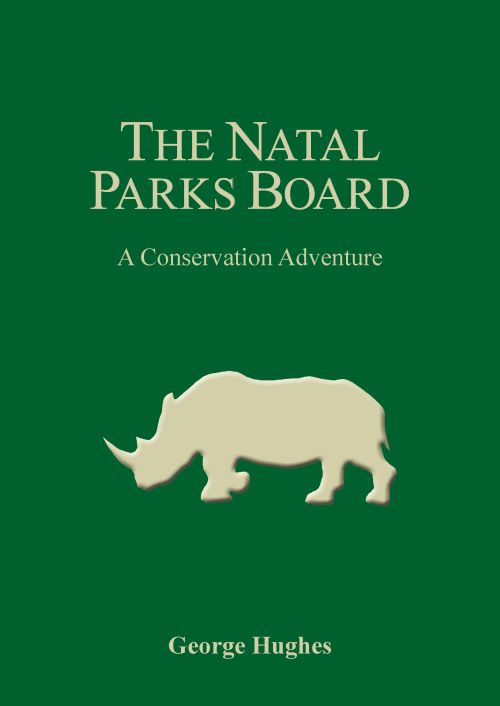
The Natal Parks Board

A Conservation Adventure

The Natal Parks Board

Occasional Publications imprint
of 
The Natal Society Foundation.
PIETERMARITZBURG

SOUTH AFRICA was first settled in 1652 and over the next 250 years experienced a plethora of early explorers, adventurers, significant migrations of both Africans and Europeans and a surge of development, bringing with it the almost complete destruction, for reasons good and bad, normal and abnormal, of its incredibly large mammal populations as well as significant declines in its general biodiversity.

Towards the end of the nineteenth century, these abundant and free natural resources that had made it possible for the region’s human populations to explore and to survive suffered from the tragedy of the commons and as a result almost ceased to exist, disappearing both as an economic resource and a source of wonder.

The Colony of Natal had taken cognisance of the threats to and declines of important species. In Zululand the first protected areas were set aside in 1895, being followed by Giant’s Castle Game Reserve in 1903. In the Transvaal, Sabi Game Reserve was created in 1898. The restoration of South Africa’s wildlife resources had begun.

From 1910 onwards, the country’s four provinces established conservation bodies and were joined in 1926 by the establishment of a National Parks Board, the form and structure of which was statutory, with a high degree of independence from normal state bureaucracy. Natal never offered any of its unique protected areas to the central government agency for declaration as national parks and, in 1944, a state delegation made a formal visit and tried to persuade the NPA to relinquish control of three historic and invaluable parks.

Natal refused, but recognised the value of having a nature conservation authority a step removed from the standard state structures, where all staff would identify with the primary goal of conservation and its controlling board would have the flexibility to take decisions with conservation as the main objective. In 1947, Natal created its own statutory authority which went on, over the next fifty years, to develop internationally recognised strategies in the fields of conservation management and development. The Natal Parks Board thus contributed to South Africa’s reputation of restoring its almost extinct large mammal resources and enthusiastically promoted the development of what would become one of the greatest wildlife industries in the world.

This is a story of the Natal Parks Board.

Dr George Hughes has been involved in conservation for virtually all his working life. Developing an early interest in birds and reptiles, encouraged by sympathetic and empathetic school teachers at Estcourt High School and endowed with a great spirit of adventure and joy of the outdoor life he became a fair hunter and passionate trout angler, being drawn to the mountains and beauty of rural Natal.

When he was 19 a friend persuaded him to join what turned out to be a two-year expedition to Europe from where, in 1960, he hitchhiked from northern Norway, through Yugoslavia and via Egypt and East Africa to take up his first formal conservation job as a learner ranger with the Natal Parks Board. After four years in Giant’s Castle Game Reserve, he went to the University of Natal and the Oceanographic Research Institute in Durban to emerge with a PhD in Zoology. Rejoining the Natal Parks Board in 1974 as a field biologist, he turned to management and be came its CEO in 1988. He retired in 2001

Book details

Publisher:Natal Society Foundation
Publication Date:2024
Text:488 pp
ISBN:978-0796135285
Editor:Christopher Merrett
Proof Reader:Catherine Munro
Design and Layout:Jo Marwick
Cover:Jo Marwick

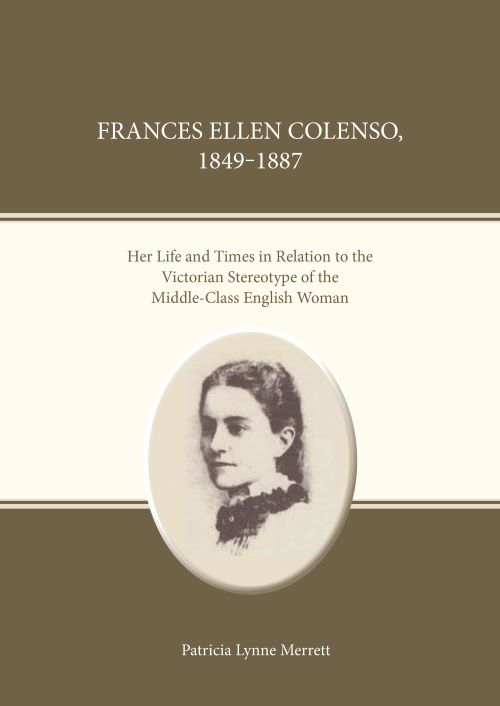
FRANCES ELLEN COLENSO

1849-1887

Her Life and Times in Relation to the

Victorian Stereotype of the

Middle-Class English Woman

Patricia Lynne Merrett

Frances Ellen Colenso 1849 - 1887

Occasional Publications imprint
of 
The Natal Society Foundation.
PIETERMARITZBURG

Frances Ellen (Fanny) Colenso was the second daughter, and second child, of Bishop John William and Sarah Frances Colenso. Her life was cut short by tuberculosis at the age of 37 in 1887, but her talents marked her out as a woman of literary and historical importance. Her achievements are used in this book, originally a thesis awarded a masters degree in 1980 by the University of Cape Town, to compare Fanny with other women writers of her century and assess her life in terms of the stereotype of the middle-class Victorian woman.
Fanny had artistic and literary ambitions. She and her elder sister Harriette were active advocates of their father’s unconventional theological and political beliefs and actions. Fanny also involved herself in the controversy surrounding Colonel Anthony Durnford’s role at the battle of Isandlwana in 1879.
She had earlier written a novel under the pseudonym Atherton Wylde entitled My Chief and I about Durnford’s conduct at the engagement with the Hlubi at Bushman’s River Pass in 1873; and then published two volumes of a history of the Anglo-Zulu War of 1879 entitled the Ruin of Zululand. A third volume was unfinished at her death. These activities, generally regarded as the realm of men, placed her outside the narrow confines of Victorian womanhood, especially in a colonial setting.
Fanny maintained her activism until very shortly before her premature death. In England during her final year, she became more radical in outlook while maintaining the Colenso doctrine that patriotic duty to country and empire required critical self-examination and adherence to truth. Not only was she a significant figure in nineteenth-century Natal, but one who has relevance today.

Book details

Publisher:Natal Society Foundation
Publication Date:2025
Text:208 pp
ISBN:978-07961-35289-2 (e-book)
Transcriber:Michelle Bartlett
Editor:Christopher Merrett
Proof Reader:Catherine Munro
Layout and Cover:Jo Marwick

A1 Occasional Publications Template

Introduction Here

image here

Occasional Publications imprint
of 
The Natal Society Foundation.
PIETERMARITZBURG

Contents here

Book details

Publisher:The Natal Society Foundation
Publication Date:
Binding:
Text:
Dimensions:
ISBN:
Transcriber:
Price:
Transcriber:
Editor:
Assistant Editors:
Transcriber:
Cartographer:
Indexer/s:
Proof Reader:
Layout and Cover:
Design and Layout:
Graphs:
Cover:
Photo Acknowledgements:
Printed by:

A1 Template Natalia
Natalia Cover 1.1
Natalia Cover 1.1

Natalia Volume

Published: Year

Category: Natalia

Format: PDF – Zip – MB

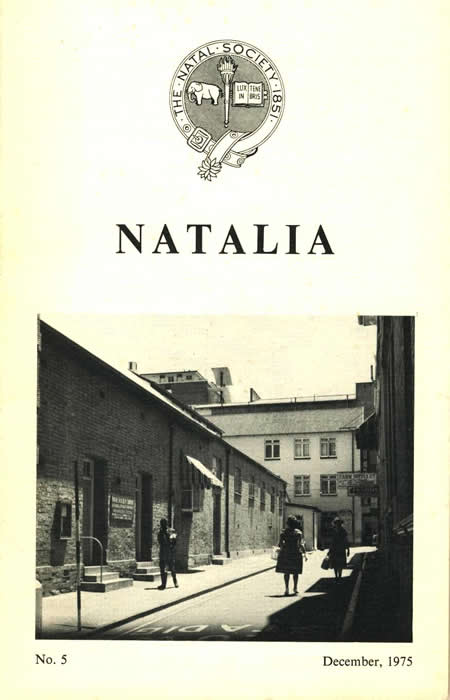
Natalia No. 5 (1975)
Natalia Cover 5.1
Natalia Cover 5.1

Natalia Volume 5

Published: 1975

Category: Natalia

Format: PDF – Zip – 4MB