All posts by

Hazara

Elegy for an African Farm

by
John Conyngham
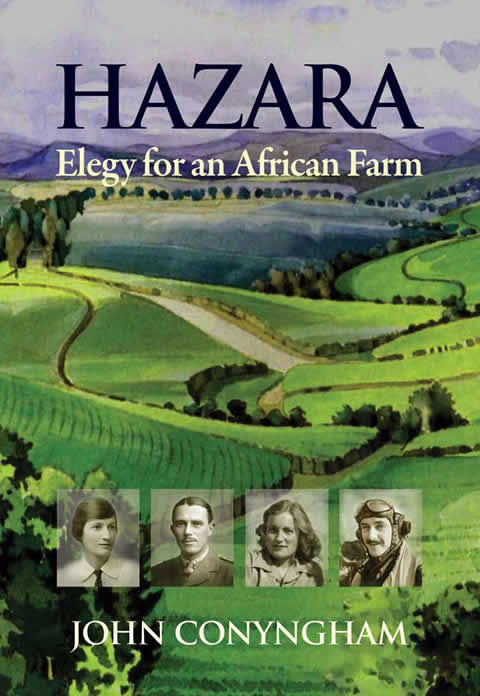
Hazara Elegy for an African Farm

Occasional Publications imprint
of 
The Natal Society Foundation.
PIETERMARITZBURG

In 1977, when John Conyngham was twenty-three, the sugar farm of his childhood and youth was sold. Driven by a sense of loss, he wrote his acclaimed novel The Arrowing of the Cane. Now, decades later, he returns to where his story began, to capture a world before it fades forever. Hazara is a lyrical memoir of a family and a farm. It is about a homestead in a park-like garden among cane fields, within sight of the Indian Ocean. It is about sons fighting in wars and daughters nursing in military hospitals. It is about tennis parties, and drinks on the veranda. It is about people who love Africa but know they don’t fully belong.

About Hazara
After their marriage in 1924, a young couple named Mia and James settle on the Natal coast, just south of the Zululand border, intending to establish themselves and start a family. Before long they name their farm Hazara, after James’s former regiment in the British Indian Army. Like other planters scattered across the countryside, they socialise with neighbours and have visitors to stay in their house with its view eastwards to the Indian Ocean. Then, after a chain of fateful occurrences, into this isolated world of sugar-cane farming, with its horse riding and games of tennis and charades, there arrives from England a girl named Anne. In World War II, James serves in North Africa while Mia and Anne remain on the farm and like other wives and daughters provide a surrogate home for Royal Navy sailors whose ships are undergoing repairs in Durban harbour. Later, back to Natal from flying operations with the Royal Air Force returns a young pilot named Mick, with a family story of his own. He and Anne meet and marry, and over decades transform Hazara into a model estate, but a political showdown is looming and their future seems increasingly uncertain. In the tradition of elegiac memoirs such as Karen Blixen’s Out of Africa, about Anglo-Kenya, and David Thomson’s Woodbrook, about Anglo-Ireland, onto this rural template John Conyngham stitches a lyrical and multi-layered tapestry of Anglo-South African life, with its interwoven destinies shot through with imperial associations, and its divided loyalties and love of the land, to catch a world before it slips from memory.

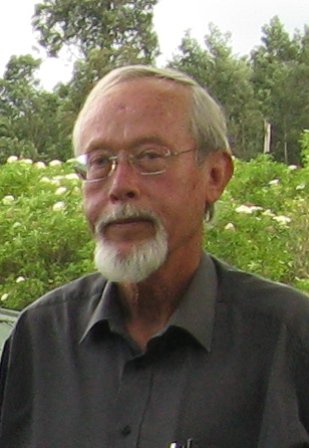
John Conyngham
John Conyngham photo: Heather Gourlay-Conyngham.

About John Conyngham

The author, John Conyngham, was born in Durban in 1954 and educated in South Africa, England and Ireland.

He is the author of three novels, The Arrowing of the Cane, which was joint winner of the AA Mutual-Ad Donker Vita Award and winner of the Olive Schreiner Prize and Sanlam Award, The Desecration of the Graves, which was shortlisted for the M-Net Award, and The Lostness of Alice.

Other than in South Africa, his work has been published in the United Kingdom and United States and translated into a number of languages. For thirty-one years he was a journalist on The Witness (formerly The Natal Witness) in Pietermaritzburg, and was from 1994 to 2010 the newspaper’s editor.

He is a former Southern African Poynter Fellow at the Poynter Institute for Media Studies in St Petersburg, Florida, and Reuters Fellow at Oxford University.

He lives in Hilton, KwaZulu-Natal.

Book details

Publisher:The Natal Society Foundation
Publication Date:2016
Binding:Hard-cover with dust jacket, thread-sewn, round back, with green and white head-bands
Text:272 pp, illustrated with photographs.
Dimensions:17.5 cm × 25 cm × 3 cm
ISBN:ISBN 978-0-9921766-8-6
Price:R150
Editor:Christopher Merrett
Indexer:Christopher Merrett
Design and Lay-out:Jo Marwick
Printed by:Pinetown Printers, Pinetown

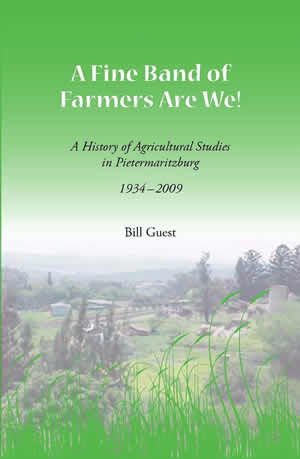
A Fine Band of Farmers are We!

A History of Agricultural Studies in Pietermaritzburg
1934-2009

By Bill Guest

Afine Band of Farmers Are We

Occasional Publications imprint
of 
The Natal Society Foundation.
PIETERMARITZBURG

This history of agricultural studies in KwaZulu-Natal over a period of 75 years, from 1934 to 2009, gives a detailed overview of the establishment of formal agricultural studies in the province and focuses on the Faculty of Agriculture at the University of KwaZulu-Natal.  Alumni of “AgFac”, as it was affectionately known, have made their mark in agricultural research not only in South Africa but also internationally.
Today the School of Agricultural Sciences and Agribusiness, which replaced the old “AgFac”, has extended into the sociological and ecological significance of agriculture for the continent as a whole through its African Centre for Food Security (ACFS), and the African Centre for Crop Improvement (ACCI). Much attention is also being paid to the improvement and popularization of traditionally useful food and craft plants indigenous to Africa. 
“Bill Guest’s scholarly research confirms that the original AgFac model, and its new millennium successor have much to be proud of … ”
~ Nigel Wolstenholme, Professor Emeritus, Faculty of Agriculture, UKZN
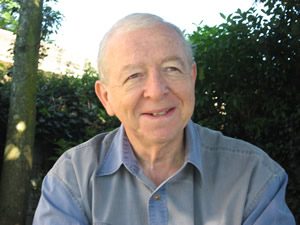
Prof Bill Guest by Cynthia Guest

The author, W.R. (Bill) Guest, is a Professor Emeritus and Senior Research Associate in Historical Studies on the Pietermaritzburg campus of the University of KwaZulu-Natal. He has authored, co-authored and co-edited ten books on South African history, focusing primarily on the Natal-Zululand region.

Book details

Publisher:The Natal Society Foundation
Publication Date:20 October 2010
Binding:Soft-cover, thread-sewn
Text:284pp, illustrated with half-tone photographs
Dimensions:15 cm x 23 cm x 1.6 cm
ISBN:978-0-620-48422-0
Price:R80
Editor:Peter Croeser
Indexer/s:Bill Guest
Design and Layout:Jo Marwick
Printed by:Interpak Books, Pietermaritzburg

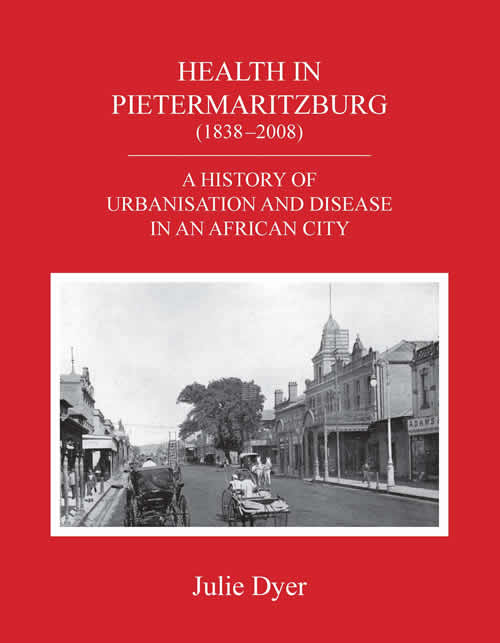
Health in Pietermaritzburg (1838 – 2008)

A history of urbanisation and disease in an African city 
by 
Julie Dyer

Health in Pietermaritzburg (1838 - 2008)

Occasional Publications imprint
of 
The Natal Society Foundation.
PIETERMARITZBURG

THIS IS A HISTORY of the health of the people of Pietermaritzburg, a developing city in Africa and capital of the province of KwaZulu-Natal in South Africa.
The book covers a period of about 170 years: from a time when a few explorers of European extraction started to settle themselves in a rural southern African valley, through the process of building and establishing a colonial town, followed by an apartheid city, and then a large multiracial and democratically governed metropolis of over 600 000 people.
It shows how this process of creating and inhabiting a city changed people’s health, for better or worse; and looks at the impact of the built environment, the physical environment, the social and economic environment, and the policy and legal environment on health status.
The book examines the history of public health as affected by the process of urbanisation, combined with the peculiar form of social engineering that took place in South Africa, particularly during the Apartheid years.
Julie Dyer
Julie Dyer, Photo Jack Dyer

Dr Julie Dyer studied medicine at the University of Leeds in the United Kingdom before coming out to South Africa and studying Public Health at the University of Natal.

She served as Medical Officer of Health for Pietermaritzburg from 1994 until 2005, during which she began her exhaustive study of the history of public health in KwaZulu-Natal’s capital city.

Book details

Publisher:The Natal Society Foundation
Publication Date:14 November 2012
Binding:Hard-cover with dust jacket, thread-sewn, round back, with red and white head-bands
Text:385 pp, illustrated with tables, graphs, photographs
Dimensions:17 cm × 24 cm × 3 cm
ISBN:978-0-992 17660-0
Price:R140
Editor:Christopher Merrett
Assistant Editors:Peter Croeser and Phila Mfundo Msimang
Indexer/s:Christopher Merrett
Design and Layout:Jo Marwick
Graphs:Mthokozisi Chilli Zwane
Printed by:Interpak Books, Pietermaritzburg

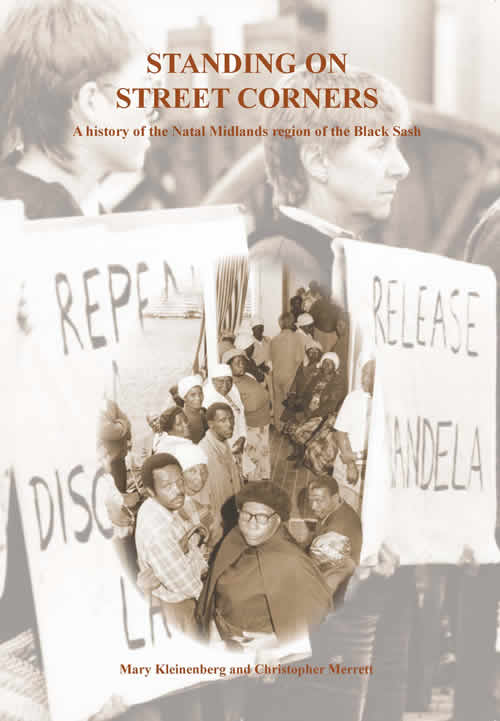
Standing on Street Corners

A history of  the Natal Midlands region of the Black Sash
by 
Mary Kleinenberg and Christopher Merrett

Standing on Street Corners

Occasional Publications imprint
of 
The Natal Society Foundation.
PIETERMARITZBURG

Nelson Mandela called the Black Sash, founded in May 1955 to contest legislation that removed coloured South Africans from the common voters’ roll in the Cape, the ‘conscience of white South Africa’. Adopting a radical critique of the national condition, Sash maintained high-profile protest against iniquitous apartheid legislation through the darkest hours of recent South African history. It also ran advice offices that assisted those disempowered by racist legislation and used the information gathered to support its political campaigns. This book chronicles the history of the Natal Midlands branch based in Pietermaritzburg.  
What was the relevance and legacy of the Black Sash, the women’s antiapartheid organisation, and what did this mean to its members? This book looks specifically at the Natal Midlands (Pietermaritzburg) region and the distinctiveness of its contribution. Like other regions it supported the liberation struggle through public protest and educational campaigns aimed at exposing iniquitous apartheid legislation. In a police state this required considerable determination and courage. During the darkest hours Natal Midlands Sash kept alive hope for universal civil rights in a democratic South Africa. The Pietermaritzburg Advice Office became one of the country’s busiest, specialising in old age pension and disability grant issues. Knowledge painstakingly gathered about life for black South Africans was fed back into Sash’s political and information campaigns while Natal Midlands produced several significant publications. One of the smaller branches, it punched above its weight. Whether Sash was a political pressure group of women, or a women’s organisation challenging patriarchy, it generated lively debate. Environmental issues were also accorded a high priority. Fifteen interviews show that involvement in Sash was a life-enhancing experience for many members who have looked back with pride and honour at their part in the anti-apartheid movement from 1955 to 1994.

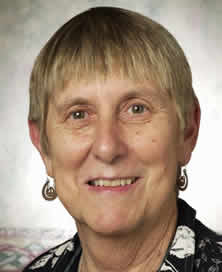
Mary Kleinenberg was born and educated in Zimbabwe (Rhodesia). She lived in Malawi and England before settling in Pietermaritzburg in the seventies. Appalled by a political system that excluded most of the population and consistently committed crimes against humanity she volunteered in the Pietermaritzburg Advice Office and became a member of Black Sash, eventually chairing the Natal Midlands region and Advice Office committee. She remains a trustee of the Black Sash Trust; and is an advocate of women’s rights, being a founder member of Pietermaritzburg Rape Crisis.

Christopher Merrett was born in Britain, grew up in the West Indies and has lived in South Africa for the past four decades. His career took him from academic librarian to university administrator, then journalism and now freelance editing and indexing. He was involved in non-racial cricket and detainee support work in 1980s and much of his writing covers human rights issues, especially censorship. He has a PhD in History from the University of Cape Town and is currently engaged in researching aspects of the recent history and politics of Pietermaritzburg.

Book details

Publisher:The Natal Society Foundation
Publication Date:16th May 2015
Binding:Hard-cover with dust jacket, thread-sewn,
round back, with black and white head-bands
Text:300 pp, illustrated with photographs
Dimensions:18 cm × 24.5 cm × 2 cm
ISBN:978-0-99217-664-8
Price:R150
Editor:Christopher Merrett
Indexer/s:Christopher Merrett
Design and Layout:Jo Marwick
Printed by:Interpak Books, Pietermaritzburg

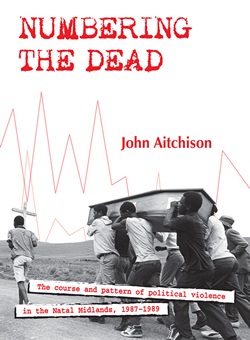
Numbering The Dead

The course and pattern of political violence in the Natal Midlands, 1987-1989 
by 
John Aitchison

Numbering the Dead

Occasional Publications imprint
of 
The Natal Society Foundation.
PIETERMARITZBURG

Numbering the Dead is a seminal account of the violent civil conflict that broke out around the city of Pietermaritzburg in 1987 and what ensued over the next three years. Aitchison and his colleagues, based at the Centre for Adult Education, documented and dissected the ebb and flow and the changing circumstances of this not-so-low intensity civil war in the region.
They collected, computerised, and categorised literally thousands of instances of eyewitness or documentary evidence, and then applied an innovative synthesis of qualitative and quantitative approaches that uncovered the patterns and intimated the underlying causes.
This book, mainly covering the period 1987 to 1989, presents a distillation of this monitoring work, conducted under unimaginably difficult and stressful conditions.

It was originally done with the simple aim of stopping the killing by telling people in the province, in South Africa and the world what was happening, as accurately and truthfully as possible.
John Aitchison

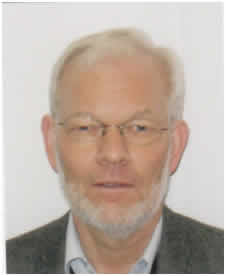
Professor John Aitchison was born in Durban and then studied at the University of Natal in Pietermaritzburg where he was active in the National Union of South African Students and in the Liberal Party. In his Honours year in 1965 he was restricted without trial under severe banning orders for five years and then again for another five years from 1971 to 1976. After teaching at the Federal Theological Seminary he joined the University of Natal, Pietermaritzburg where for many years he headed the Centre for Adult Education. Later he was head of the School of Education Training and Development. He retired in 2007 and is an Emeritus Professor of the University of KwaZulu-Natal. He ran an Unrest Monitoring Project in the Centre for Adult Education from 1987 to 1994 and has played a significant role in national adult education policy development as well as in the development of school teacher upgrading programmes. He is known for his strong commitment to education and non-governmental organisation development in the Natal Midlands. He has been active in a number of human rights and rural development non-governmental organisations such as the Association for Rural Advancement (of which he was Director for a time).

Book details

Publisher:The Natal Society Foundation
Publication Date:25 April 2015
Binding:Hard-cover with dust jacket, thread-sewn,
round back, with red and white head-bands
Text:
274 pp, illustrated with tables, graphs, maps
Dimensions:18 cm × 24.5 cm dee × 2 cm
ISBN:978-0-992-17663-1
Price:R120
Editor:Christopher Merrett
Assistant Editors:Peter Croeser and Phila Mfundo Msimang
Cartographer:
Indexer/s:Christopher Merrett
Design and Layout:Jo Marwick
Graphs:Jo Marwick
Printed by:Interpak Books, Pietermaritzburg

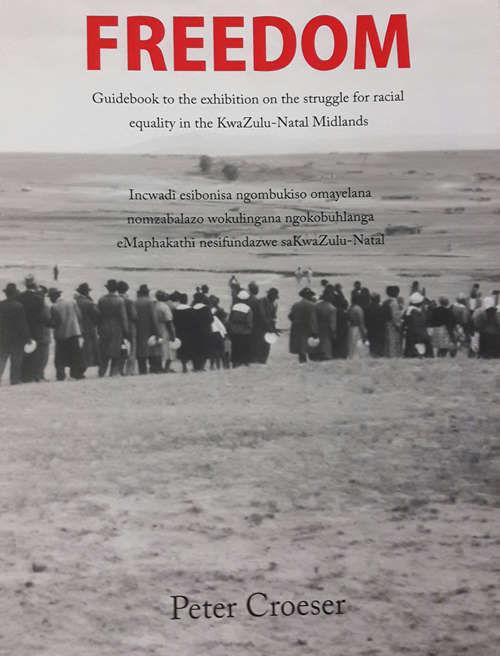
Freedom

The Freedom Struggle

by
Peter Croeser

Freedom Guidebook to KZN

Occasional Publications imprint
of 
The Natal Society Foundation.
PIETERMARITZBURG

The Freedom Struggle was compiled and written by Peter Croeser to accompany a permanent exhibition on the struggle for racial equality in the KwaZulu-Natal Midlands opened in September 2013 at the KwaZulu-Natal Museum.  It is published in association with the Natal Society Foundation.

The book covers a wide sweep of history from the San gatherers of 20 000 BC onwards, setting the history of the region against its sub-continental and national background. It moves from early African farmers to the arrival of first Voortrekkers, then the British, and via the wars of the nineteenth century to the eras of segregation and apartheid. The struggles of the disenfranchised culminated in regional violence at the end of apartheid that led to adoption of a democratically-inspired national Constitution in 1996.

Amongst the prominent individuals populating this commentary are John William Colenso, Cetshwayo, Langalibalele, Mohandas Gandhi and Alan Paton.  But the voices of ordinary people of the area emerge strongly: for instance, the Kholwa of Edendale, the Indian and coloured families forced to relocate in the 1960s as a result of the Group Areas Act, the strikers at BTR Sarmcol, and those who suffered as a result of low-intensity conflict (in particular the Seven-Day War) in the late 1980s.

This is primarily a people’s history, much of it based on audio-visual interviews about the role of community and national non-governmental organisations and the memories of local residents and leaders.
Peter Croeser
Peter Croeser (17 June 1949 – 29 October 2016)

About Peter Croeser

The Freedom Struggle was published posthumously as Peter Croeser died on 29 October 2016 at the age of 67. He worked at the KZN Museum for 26 years, first as an arachnologist and later as chief education officer until retirement in 2008. He continued to work for the museum as a consultant and in 2015 became a minister-appointed member of the Museum Council.  
 
He also served as a past chair of the Natal Society Foundation and was its administrator at the time of his death. An obituary can be found elsewhere on this website.

Book details

Publisher:KwaZulu-Natal Museum
in association with the Natal Society Foundation.
Publication Date:2016
ISBN:978-0-9921766-5-5

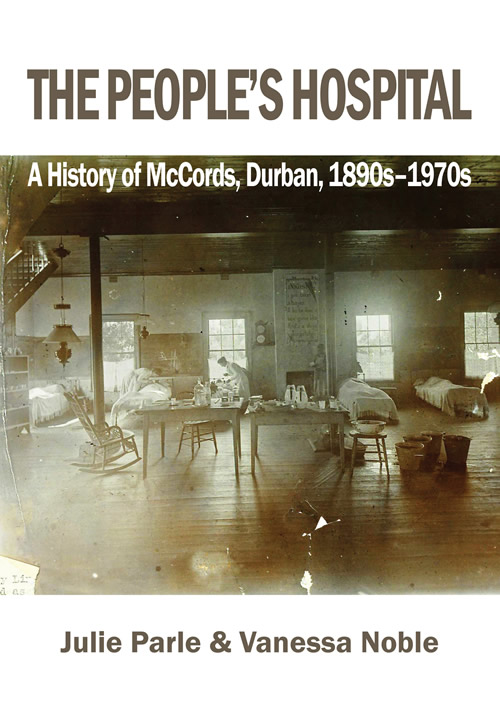
The People’s Hospital

A History of McCords, Durban, 1890s-1970s
by
Julie Parle and Vanessa Noble

The Peoples Hospital

Occasional Publications imprint
of 
The Natal Society Foundation.
PIETERMARITZBURG

Vanessa Noble is a lecturer in Historical Studies at the University of KwaZulu-Natal. She has published on the histories of health and healing in South Africa.

Book details

Publisher:The Natal Society Foundation
Publication Date:15 Feb 2018
Binding:Paperback, section sewn
Text:241 pp. illustrated with photographs
Dimensions:24 cm x 17 cm x 1.5 cm
ISBN:978-0-9921766-9-3
Price:R160
Editor:Christopher Merrett
Indexer/s:Christopher Merrett
Proof Reader:Cathy Rich Munro
Design and Layout:Jo Marwick
Printed by:CPW Printers, Pietermaritzburg

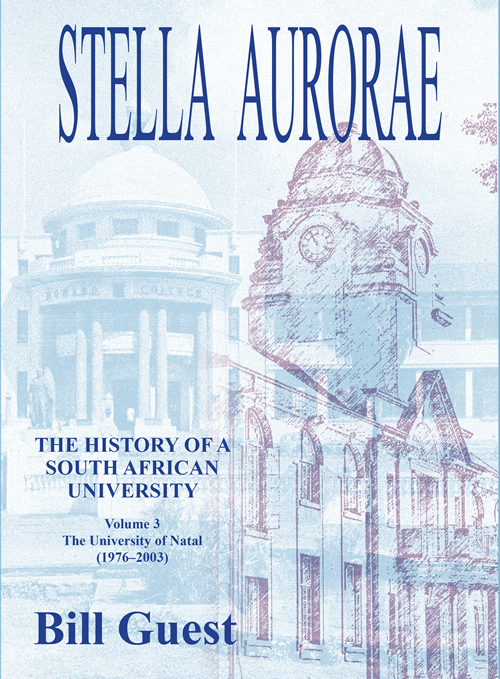
Stella Aurorae v3

The history of a South African University

Volume 3
The University of Natal (1976 to 2003)

by 
Prof. Bill Guest

Stella Aurorae V 3

Dust jacket front cover illustrations based on a photograph of Howard College campus in the archives of the Universityf KwaZulu-Natal and a photograph of Old Main Building, Pietermaritzburg campus, taken by Jack Frost in 1955.

Occasional Publications imprint
of 
The Natal Society Foundation.
PIETERMARITZBURG

This is the last of a three-volume history by Bill Guest of a major South African university founded as the Natal University College in Pietermaritzburg in 1909. Despite trying conditions, including two world wars, the university expanded, developed a second campus (Howard College) in Durban and became the University of Natal in 1949.   
Thereafter until the mid-1970s the university continued to develop a dual-centred institution while struggling to maintain its autonomy. This included control of a third campus, a blacks-only medical school, in the face of interference from the apartheid government. The administrative centre of gravity shifted inexorably towards Durban as student enrolments and course options increased in the larger city, which also had many more potential donors.
This final volume covers the tumultuous years from 1976 to 2003 during which many of the university’s staff and students became embroiled in resistance to apartheid and then engaged with the consequences once the country had achieved political freedom in 1994. Some contributed to the formulation of national government policies for the new South Africa and in the restructuring of the university as it became completely desegregated and coped with financial constraints.
Meanwhile it had also become a four-campus institution with the incorporation of Edgewood College of Education; and eventually five following its 2004 merger with the University of Durban-Westville to form the University of KwaZulu-Natal.
In addition to other sources, including staff and student reminiscences, the author draws extensively on the University’s archive of publications, reports, documents and minutes of meetings, recalling both the serious and the lighter side of campus life.  
Prof Bill Guest by Cynthia Guest

W.R. (Bill) Guest is a professor emeritus and senior research associate in Historical Studies on the Pietermaritzburg campus of the University of KwaZulu- Natal.
A doctoral graduate of the Howard College (Durban) campus of the former University of Natal, he has published a variety of articles and has authored, co-authored, edited and co-edited more than a dozen books on South African history, focusing primarily on the socio-economic and institutional history of the Natal-Zululand region.
In 2013 he won an Amafa AKwazulu-Natali Award in recognition of his contribution towards heritage conservation in the province.

Book details

Publisher:The Natal Society Foundation
Publication Date:2019
Binding:Hard-cover with dust jacket, thread-sewn, round back, with blue and white head-bands
Text:616pp, illustrated with photographs
Dimensions:18 cm x 24.5 cm x 4.5 cm
ISBN:978-0-9921766-6-2
Price:R200
Editor:
Christopher Merrett
Indexer/s:Cynthia and Bill Guest
Proof Reader:Cathy Munro
Design and Layout:Jo Marwick
Photo Acknowledgements:All photographs courtesy of UKZN Archives and Killie Campbell Museum Library
Printed by:CPW Printers Pietermaritzburg

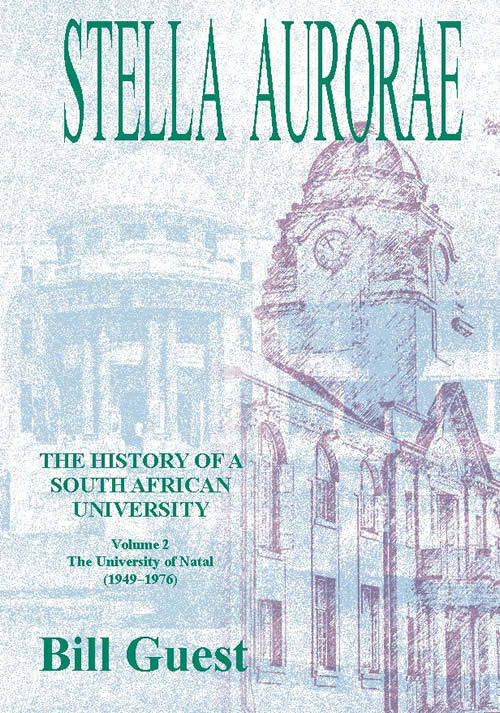
Stella Aurorae v2

The history of a South African University

Volume 2
Natal University College (1949 to 1976)

by 
Prof. Bill Guest

Stella Aurorae V 2

Dust jacket front cover illustrations based on a photograph of Howard College campus in the archives of the Universityf KwaZulu-Natal and a photograph of Old Main Building, Pietermaritzburg campus, taken by Jack Frost in 1955.

Occasional Publications imprint
of 
The Natal Society Foundation.
PIETERMARITZBURG

This is the second of a three-volume history by Bill Guest of a major South African university founded as the Natal University College in Pietermaritzburg in 1909. Despite trying conditions, including two world wars, the university expanded, developed a second campus (Howard College) in Durban and became the University of Natal in 1949.
The first volume covered the history of Natal University College from 1909 to 1949.
This volume covers the years 1949 to 1976 during which the university continued to develop as a dual-centred institution while struggling to maintain its autonomy.
This included control of a new third campus, a blacks-only medical school, in the face of interference from the apartheid government.
The administrative centre of gravity shifted inexorably towards Durban as student enrolments and course options increased in the larger city.

In addition to other sources the author draws extensively on the university archives of publications, reports, documents, reminiscences and minutes of meetings, recalling both the serious as well as the lighter side of campus life.

Volume three
will focus on the tumultuous years from 1977 to 2003 in which many of the university’s staff and students became embroiled in the resistance to apartheid and then engaged with the consequences once the country had achieved political freedom in 1994.
Some contributed to the formulation of national government policies for the new South Africa and in the restructuring of the university as it became completely desegregated and coped with financial constraints.
Prof Bill Guest by Cynthia Guest

W.R. (Bill) Guest is a professor emeritus and senior research associate in Historical Studies on the Pietermaritzburg campus of the University of KwaZulu- Natal.
A doctoral graduate of the Howard College (Durban) campus of the former University of Natal, he has published a variety of articles and has authored, co-authored, edited and co-edited more than a dozen books on South African history, focusing primarily on the socio-economic and institutional history of the Natal-Zululand region.
In 2013 he won an Amafa AKwazulu-Natali Award in recognition of his contribution towards heritage conservation in the province.

Book details

Publisher:The Natal Society Foundation
Publication Date:2017
Binding:Hard-cover with dust jacket, thread-sewn, round back, with blue and white head-bands
Text:476pp, illustrated with photographs
Dimensions:18 cm x 24.5 cm x 3.5 cm
ISBN:978-0-9921766-6-2
Price:R180
Editor:Christopher Merrett
Assistant Editors:Peter Croeser and Phila Mfundo Msimang
Indexer/s:Cynthia and Bill Guest
Proof Reader:Cathy Munro
Design and Layout:Jo Marwick
Photo Acknowledgements:T.B. (Jack) Frost (1955: Oribi pool party, p. 138).
All other photographs: courtesy of UKZN Archives and Killie Campbell Museum Library
Printed by:CPW Printers

Stella Aurorae v1

The history of a South African University

Volume 1
Natal University College (1909-1949)

by 
Prof. Bill Guest

Stella Aurorae V 1

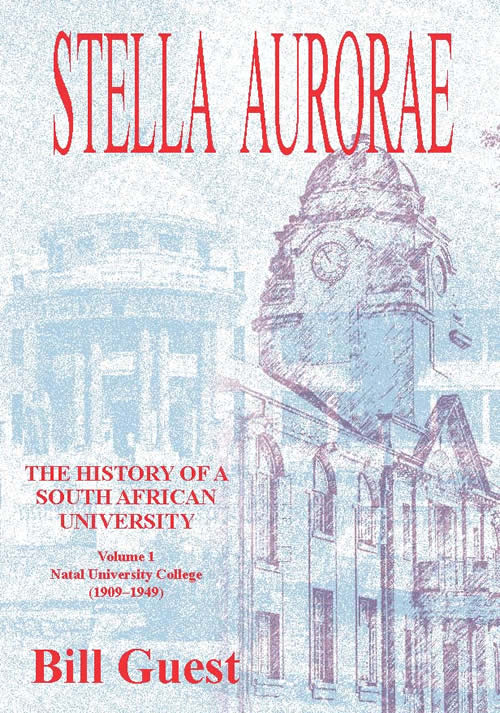
Dust jacket front cover illustrations based on a photograph of Howard College campus in the archives of the Universityf KwaZulu-Natal and a photograph of Old Main Building, Pietermaritzburg campus, taken by Jack Frost in 1955.

Occasional Publications imprint
of 
The Natal Society Foundation.
PIETERMARITZBURG

This is the first of a three-volume history by Bill Guest of a major South African university founded as the Natal University College in Pietermaritzburg in 1909. Despite trying conditions, including two world wars, the university expanded, developed a second campus (Howard College) in Durban and became the University of Natal in 1949.
This volume covers the Natal University College years from 1909 to 1949. It looks at the personalities, events and significant milestones in the early history of the university’s two city campuses that helped shape its future role as one of the country’s leading universities.
The author draws extensively on the university archives of publications, reports, documents, reminiscences and minutes of meetings, recalling both the serious as well as the lighter side of campus life.  An appendix lists all those who received degrees, diplomas and certificates from Natal University College before 1948.
Volume two, to be published during 2016, will deal with the period from 1949 until 1976 during which the university struggled to maintain its autonomy in the face of interference from the apartheid government.

Volume three will focus on the tumultuous years from 1977 to 2003 in which many of the university’s staff and students became embroiled in the resistance to apartheid and then had to engage with the consequences once the country had achieved political freedom in 1994.
Prof Bill Guest by Cynthia Guest
The author, Bill Guest, is professor emeritus and senior research associate in Historical Studies at the University of KwaZulu-Natal. Most of his academic career, starting as a student in 1959, was spent at the university where he also did his Honours, Masters and doctoral degrees.

He began his academic studies at Howard College where he also lectured before taking up a post as senior lecturer on the Pietermaritzburg campus in 1977.  There he later became associate professor, professor and senior professor. 
He has published a variety of articles and has authored, co-authored and co-edited a dozen books on South African history, focusing primarily on the Natal-Zululand region.

Book details

Publisher:The Natal Society Foundation
Publication Date:5 December 2015
Binding:Hard-cover with dust jacket, thread-sewn, round back, with blue and white head-bands
Text:391 pp, illustrated with photographs and complete list of graduates from inception to 1949
Dimensions:18 × 24.5 × 3.5 cm
ISBN:978-0-9921766-2-4
Price:R120
Editor:Christopher Merrett
Assistant Editors:Peter Croeser and Phila Mfundo Msimang
Indexer/s:Cynthia and Bill Guest
Printed by:CPW Printers Pietermaritzburg